
- Published on
- Views
E-Commerce Platform System Design (Amazon, eBay)
- Authors

- Name
- Javed Shaikh
Overview
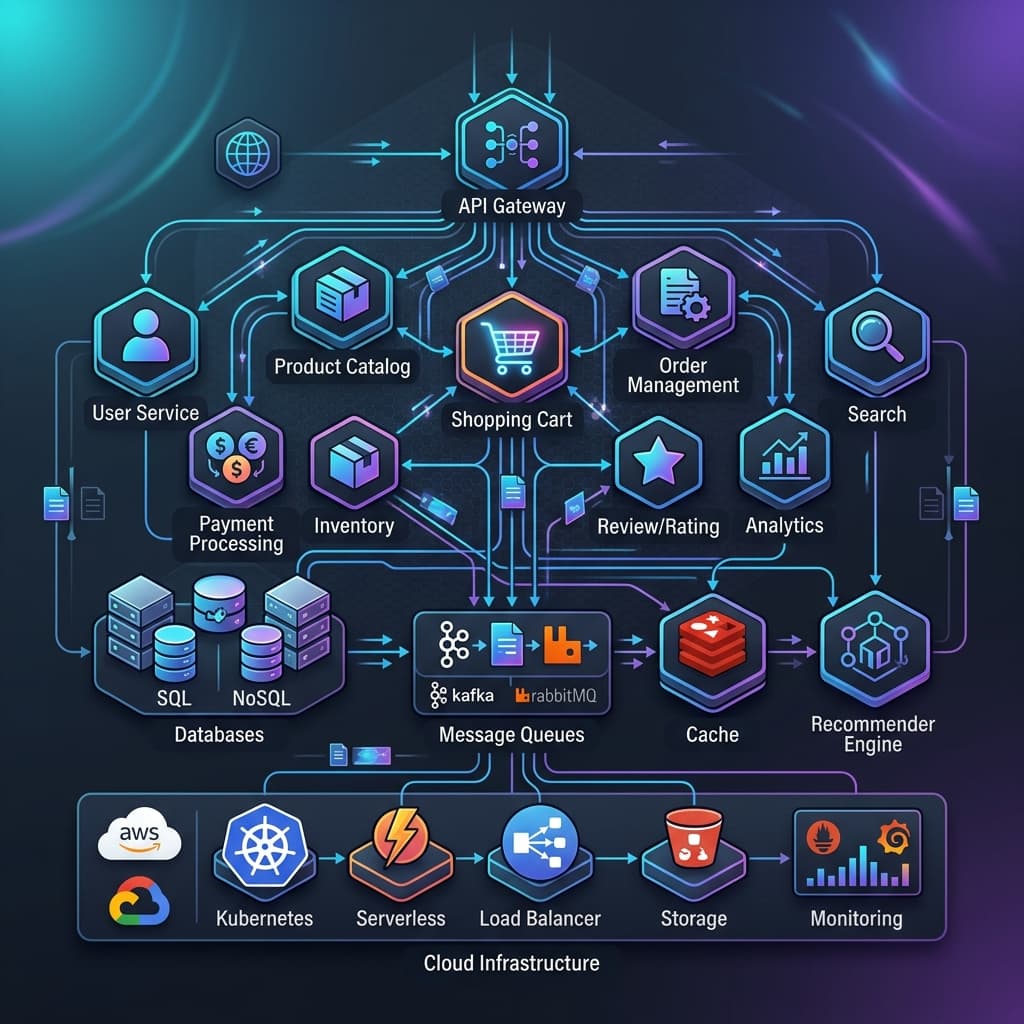
Designing a large-scale e-commerce platform like Amazon or eBay is one of the most classic and comprehensive system design problems. It touches upon nearly every pillar of distributed systems — from real-time inventory management to event-driven order processing, from search optimization to payment security.
In this deep-dive, we'll walk through the High-Level Design (HLD) and Low-Level Design (LLD) of such a platform, covering every critical flow a user interacts with.
What We'll Cover
- Requirements — Functional & Non-Functional
- Estimates — QPS & Storage
- Data Model — Core Entities & Relationships
- API Design — RESTful Endpoints
- Product Browsing Flow — Search, Cache, Inventory
- Cart Management Flow — Add, Update, Remove Items
- Checkout and Order Placement Flow — Payment, Kafka, Workers
- Complete Architecture — End-to-End System
- Additional Discussion Points — Security, Scaling, Monitoring
Requirements
Functional Requirements
| Requirement | Description |
|---|---|
| User Authentication | Enables login for cart persistence and order history. |
| Product Catalog | Allows browsing by category and searching by keyword with key details (e.g., price, availability). |
| Shopping Cart | Supports adding, updating, or removing items, persisted for logged-in users. |
| Order Management | Facilitates order placement, history, and status tracking. |
| Payment Processing | Supports multiple methods (e.g., credit card) and refunds securely. |
| Inventory Management | Ensures real-time stock updates (reduce on order, increase on return). |
Non-Functional Requirements
| Requirement | Description |
|---|---|
| Scalability | Handle millions of users and transactions (e.g., horizontal scaling with load balancers, sharded databases), and support traffic spikes (e.g., Black Friday sales) using auto-scaling and caching. |
| Performance | Low latency for search and page loads (e.g., < 200ms for product searches), and fast checkout process to minimize cart abandonment. |
| Availability | The system should be reliably accessible at all times, with minimal downtime (e.g., using redundancy, multi-region deployment). |
| Security | Enforces encryption (TLS, HTTPS) and PCI DSS compliance. |
Not Covered
The following features are typical in a production e-commerce system but are excluded here due to interview time constraints.
- Notifications: Email or SMS updates for orders and promotions (full notification system design is a separate topic).
- Reviews and Ratings: User-generated product feedback.
- Seller Portal: Tools for third-party sellers to manage listings.
Estimates
In this section, we estimate Query Per Second (QPS) and storage needs for the e-commerce system with simplified back-of-the-envelope calculations, suitable for an interview's time constraints.
Query Per Second (QPS) Estimates
Assumptions:
- 10M daily active users (DAU)
- Peak traffic is 2x average
- Traffic breakdown: ~80% browsing/search, ~20% checkout
Calculation:
10M users/day × 10 page views/user = 100M views/day

100M / (24 × 3600 seconds) ≈ 1,150 QPS (average)

Peak QPS = 1,150 × 2 = 2,300 QPS
Storage Requirements
Assumptions:
- 10M users, 100M products, 1M orders/day, 1-year retention
Calculation:
Users:    10M × 1KB/user        = 10 GB
Products: 100M × 10KB/product   = 1 TB
Orders:   1M/day × 5KB × 365    = 1.825 TB

Total = 10GB + 1TB + 1.825TB   ≈ 2.84 TB
Note: These are simplified estimates for interview brevity. A more comprehensive analysis (e.g., splitting QPS by operation or factoring in replication) is more accurate but omitted here due to time constraints of an interview.
Data Model
The data model encapsulates the core entities required to support the e-commerce system's functionality. It's designed to be simple yet extensible for an interview setting.
Core Entities
| Entity | Purpose |
|---|---|
| User | Authentication, personalization |
| Product | Catalog data |
| Inventory | Stock management (separate from products) |
| Cart, CartItem | User shopping cart tracking |
| Order, OrderItem | Order details and inventory linking |
| Payment | Transaction details and tracking |
Relationships
User → Cart           (One-to-One)
Cart → CartItem       (One-to-Many)
Product → CartItem    (Many-to-One)
User → Order          (One-to-Many)
Order → OrderItem     (One-to-Many)
Product → OrderItem   (Many-to-One)
Order → Payment       (One-to-One)
Product → Inventory   (One-to-One)
API Design
This API design outlines the core RESTful endpoints for the e-commerce system, focusing on the main user flows expected in an interview. All endpoints assume secure communication (HTTPS) and user authentication via a token (e.g., JWT in the Authorization header).
POST /auth/login
Authenticates user.
// Request
{ "email": "user@example.com", "password": "password123" }

// Response (200)
{ "token": "jwt_token", "user_id": 123 }
GET /products?category_id=5&search=phone&page=1&limit=20
Lists products with filters.
// Response (200)
{
  "products": [
    { "id": 1, "name": "Smartphone", "price": 699.99 }
  ],
  "total": 100
}
POST /cart/items
Adds item to cart.
// Request
{ "product_id": 1, "quantity": 2 }

// Response (201)
{ "message": "Item added" }
POST /orders
Places order.
// Request
{ "payment_method": "credit_card", "shipping_address": "123 Main St" }

// Response (201)
{ "order_id": 789, "total_amount": 1399.98 }
POST /orders/{id}/pay
Processes payment.
// Request
{ "payment_token": "token" }

// Response (200)
{ "payment_id": 101, "status": "completed" }
Product Browsing Flow
Client App
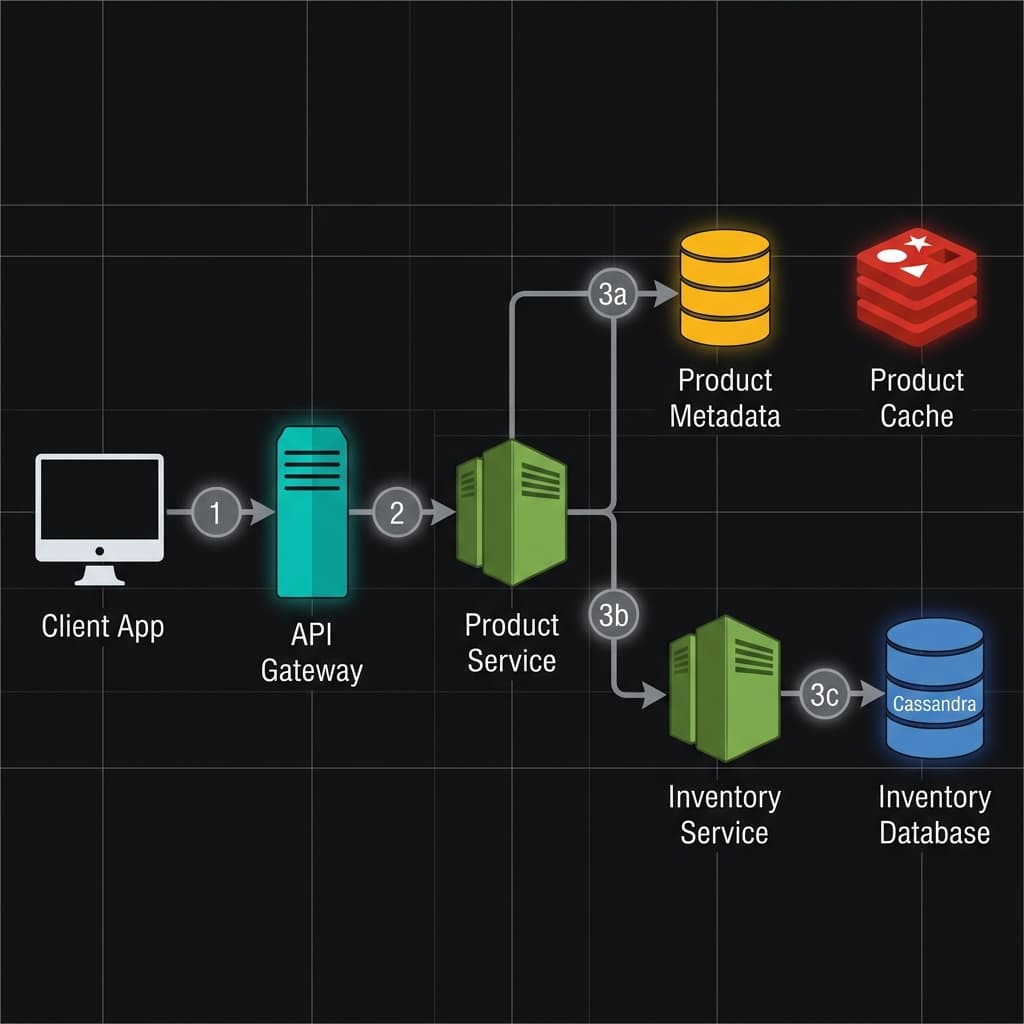
User Action: The user sends a request to browse products via GET /products?search=smartphone.
API Gateway
Routing: The API Gateway receives the request, authenticates the user, applies rate limiting, and forwards the request to the Product Service.
Additional Functionality:
- Authentication and Authorization: Verifies the JWT token.
- Rate Limiting: Prevents abuse by limiting the number of requests per user.
- Load Balancing: Distributes requests across multiple instances of the Product Service using a Round Robin approach for optimal load distribution.
Product Service
Elasticsearch: Queries an Elasticsearch index for product metadata. Elasticsearch is used due to:
- Full-text search capabilities (keyword, category filters).
- Typo tolerance and low latency (<200ms).
- Horizontal scalability to millions of products.
Redis: Caches frequently accessed product metadata (read-heavy data) with a short TTL (e.g., 5 minutes), reducing latency and load on Elasticsearch.
Inventory Service
Independently called by the Product Service to fetch real-time stock data.
- Maintains accurate stock counts.
- Utilizes a strongly consistent store (e.g., Cassandra with Lightweight Transactions, PostgreSQL, or Redis locks) to prevent overselling and ensure atomicity, especially critical during high-traffic periods (e.g., Black Friday).
Why Cassandra? Cassandra is a great option here — its blend of high write performance, horizontal scalability, tunable consistency, and built-in atomicity via LWT makes it an ideal choice for the Inventory Service. It excels in high-traffic, write-heavy scenarios, ensuring stock accuracy without sacrificing availability. Perfect for a robust e-commerce browsing flow.
Response
Product Service aggregates the search results (from Elasticsearch/Redis) with stock data (from Inventory Service) and returns:
{
  "products": [
    { "id": 1, "name": "Smartphone", "price": 699.99, "stock_quantity": 50 }
  ]
}
Cart Management Flow
Client App
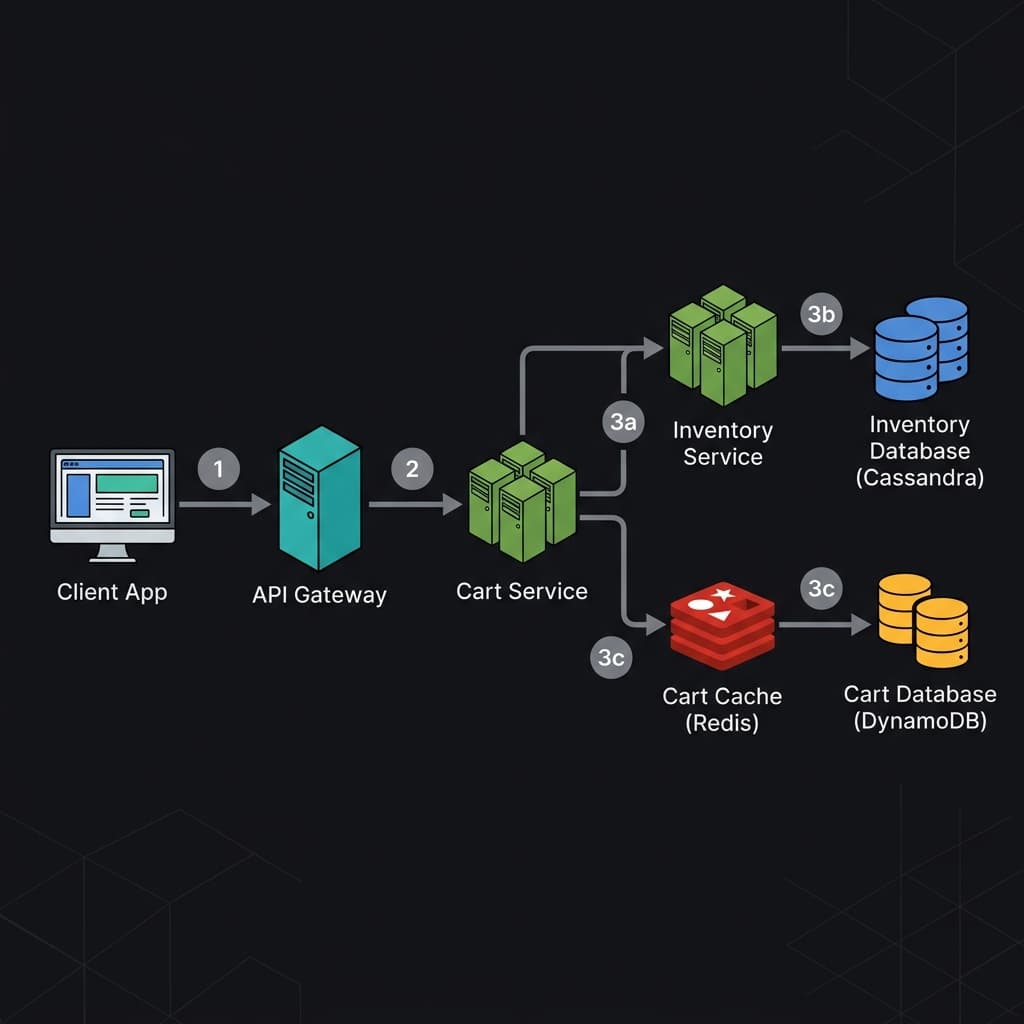
User Action: The user adds a product via POST /cart/items with {"product_id": 1, "quantity": 2}.
API Gateway
Routing: Receives the request, authenticates the user via JWT, applies rate limiting, and forwards it to the Cart Service.
Cart Service
Inventory Service: Independently called by the Cart Service to verify real-time stock availability.
- Checks if sufficient stock is available for the requested quantity.
- If stock is insufficient, the Cart Service returns an error:
{"error": "Insufficient stock"}.
DynamoDB: Used to store cart items due to:
- Single-digit millisecond latency.
- Auto-scaling capabilities, suitable for millions of concurrent carts.
- Eventual consistency is acceptable for cart updates (non-critical).
Redis: Caches user's cart data for quick retrieval (GET /cart), reducing DynamoDB load. Given frequent updates, a longer TTL (e.g., 24 hours) is appropriate.
Response
If inventory check passes, returns: {"message": "Item added"}.
Supports additional operations: PUT (update quantity), DELETE (remove item).
Checkout and Order Placement Flow
Client App
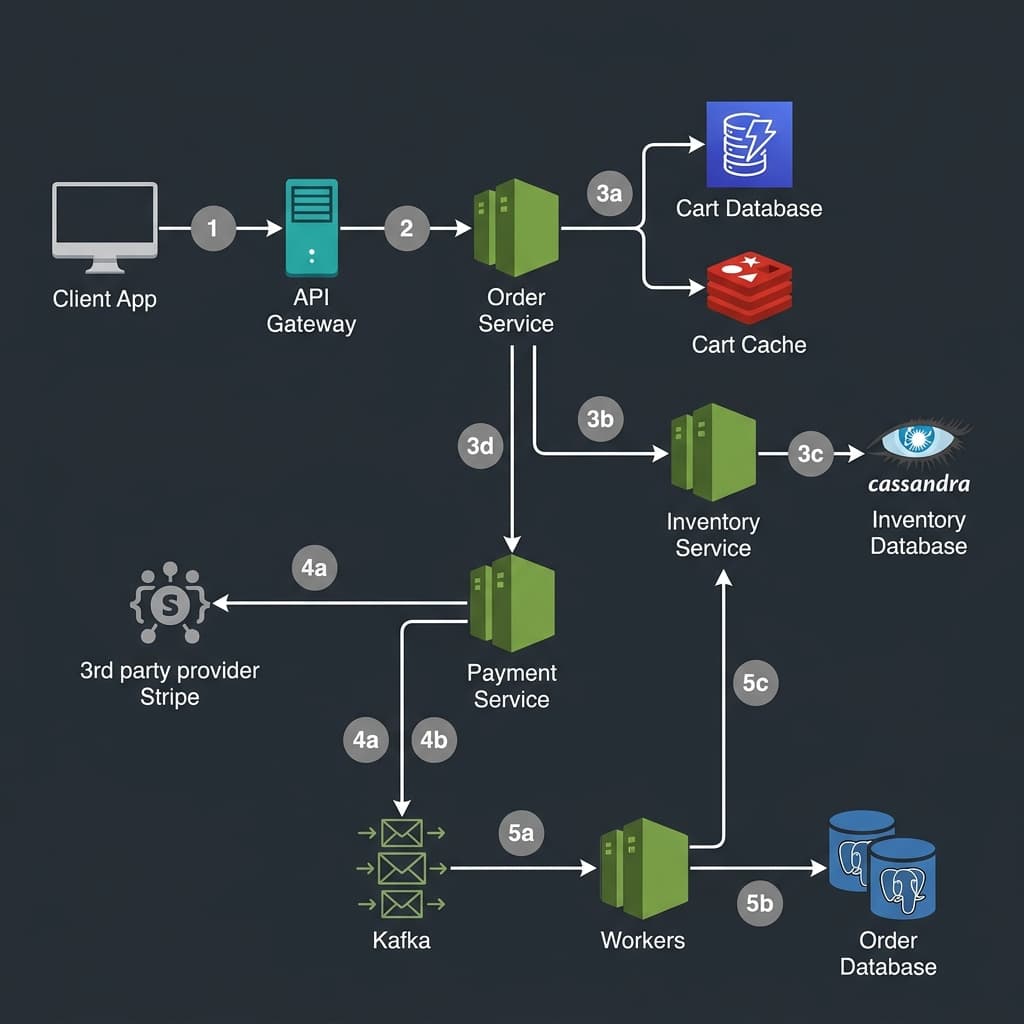
User Action: User initiates checkout via POST /orders with:
{ "payment_method": "credit_card", "shipping_address": "123 Main St" }
API Gateway
Routing: Authenticates the user (JWT verification), applies rate limiting, and correctly forwards the request to the Order Service.
Order Service
Cart Retrieval: Retrieves the user's cart from DynamoDB or the Redis cache.
Inventory Validation & Reservation:
- Calls the dedicated Inventory Service to atomically reserve stock.
- Inventory Service manages reservations using a strongly consistent store (Cassandra Lightweight Transactions, PostgreSQL transactions, or Redis distributed locks).
- If insufficient stock exists, returns an error to the client:
{"error": "Insufficient stock available"}.
Payment Processing: Calls Payment Service (POST /orders/{order_id}/pay) to securely process payment via Stripe.
Payment Service
Third Party Payment Provider: Stripe is used as the payment gateway for secure transactions (security requirement) and supports multiple payment methods (functional requirement). It handles retries and refunds externally.
Async Processing: After successful payment confirmation, publishes an event to a message queue (e.g., Kafka).
Worker (Async via Kafka Events)
Order Storage: Saves orders and order items in the Order Database.
Why PostgreSQL? PostgreSQL's ACID compliance, relational model, transactional consistency, and durability make it a great choice for the Order Database. It ensures order data is accurate, queryable, and resilient — key requirements for an e-commerce system's checkout flow, especially under pressure. While alternatives like DynamoDB or Cassandra excel in other areas, PostgreSQL's strengths align perfectly with the need for trustworthy, structured order management.
Inventory Confirmation: Finalizes the reserved stock deduction atomically through the Inventory Service.
Response
After successful processing, the Order Service returns:
{ "order_id": 789, "total_amount": 1399.98 }
Complete Architecture
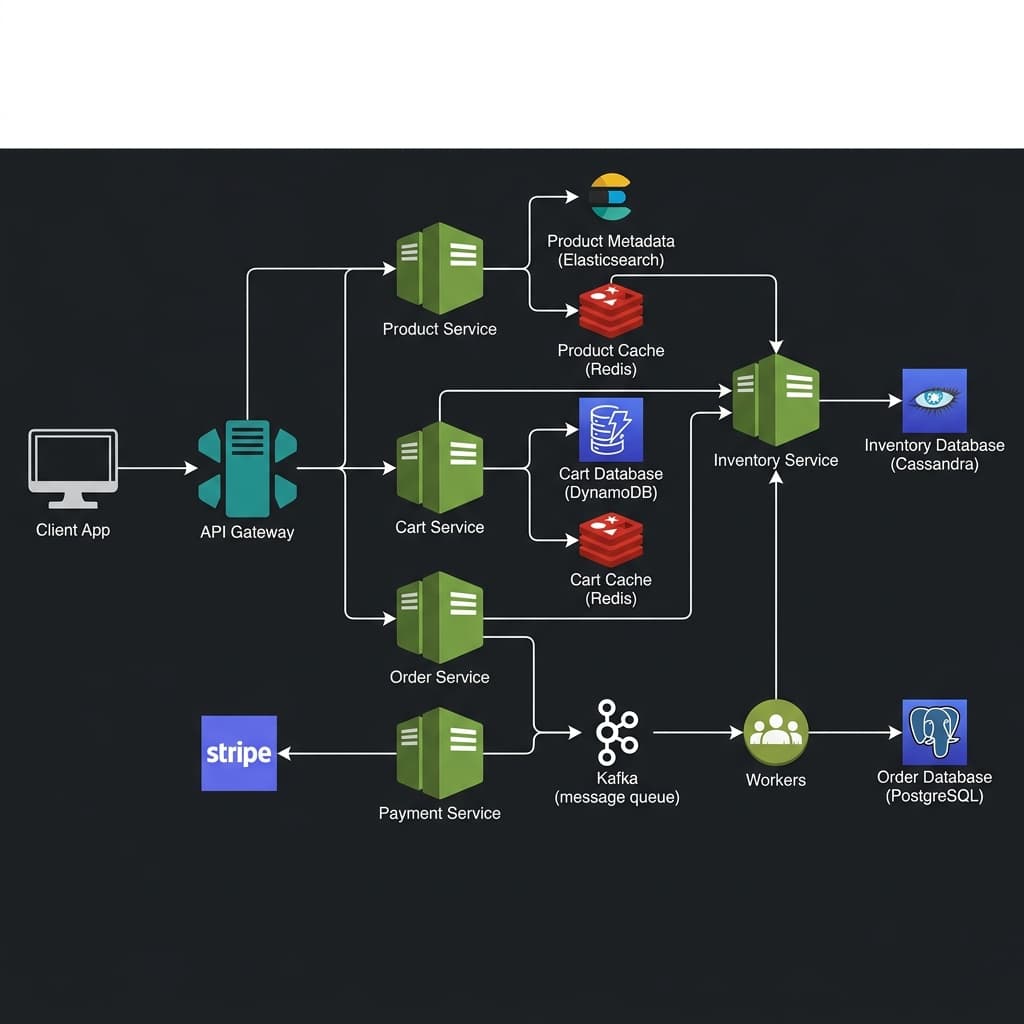
The complete architecture brings together all the individual flows into a cohesive, event-driven microservices system. Here's a summary of the key components:
| Component | Technology | Role |
|---|---|---|
| API Gateway | Custom / Kong / NGINX | Authentication, rate limiting, routing, load balancing |
| Product Service | Spring Boot / Node.js | Product search and catalog management |
| Product Metadata | Elasticsearch | Full-text search with typo tolerance |
| Product Cache | Redis | Low-latency caching for read-heavy product data |
| Cart Service | Spring Boot / Node.js | Cart CRUD operations with inventory validation |
| Cart Database | DynamoDB | Fast, scalable cart persistence |
| Cart Cache | Redis | Quick cart retrieval |
| Order Service | Spring Boot / Node.js | Checkout orchestration and order creation |
| Payment Service | Spring Boot / Node.js | Secure payment processing |
| Third Party Provider | Stripe | External payment gateway |
| Message Queue | Apache Kafka | Async event-driven processing |
| Workers | Consumer Services | Order storage, inventory finalization |
| Order Database | PostgreSQL | ACID-compliant order storage |
| Inventory Service | Spring Boot / Node.js | Real-time stock management |
| Inventory Database | Cassandra | High-write, horizontally scalable stock store |
Additional Discussion Points
🔐 Security and Compliance
- TLS/HTTPS encryption for all communication.
- PCI DSS compliance for payment data handling.
- JWT-based authentication with token expiration and refresh tokens.
- Input validation and sanitization at the API Gateway level.
- Secret management via tools like AWS Secrets Manager or HashiCorp Vault.
⚖️ Load Balancing and Scalability
- Horizontal scaling with auto-scaling groups behind a load balancer.
- Database sharding for large datasets (e.g., orders by user ID range).
- Read replicas for read-heavy workloads.
- CDN integration for static assets and product images.
- Connection pooling for efficient database connections.
🛡️ Error Handling and Reliability
- Circuit breaker pattern (e.g., Hystrix/Resilience4j) to prevent cascade failures.
- Retry logic with exponential backoff for transient failures.
- Dead letter queues (DLQ) in Kafka for failed event processing.
- Idempotency keys to prevent duplicate orders and payments.
- Graceful degradation — show cached data when services are temporarily down.
📊 Monitoring and Logging
- Distributed tracing (e.g., Jaeger, Zipkin) for request flow visibility.
- Centralized logging (e.g., ELK Stack — Elasticsearch, Logstash, Kibana).
- Metrics dashboards (e.g., Grafana + Prometheus) for latency, error rates, throughput.
- Alerting (e.g., PagerDuty) for SLA breaches and anomalies.
- Health checks for every microservice via
/actuator/healthendpoints.
Wrapping Up
This system design demonstrates how a modern e-commerce platform leverages event-driven architecture, microservices, and distributed databases to handle millions of users, ensure real-time inventory accuracy, and provide a seamless shopping experience.
The key takeaways:
- Separate concerns — Each service owns its domain (Product, Cart, Order, Payment, Inventory).
- Choose the right database — Use the best tool for each job (Elasticsearch for search, DynamoDB for cart, PostgreSQL for orders, Cassandra for inventory).
- Async processing — Kafka decouples payment confirmation from order storage, improving resilience and throughput.
- Cache aggressively — Redis sits in front of every read-heavy data source.
- Design for failure — Circuit breakers, retries, idempotency, and DLQs ensure the system stays up under pressure.
Stay tuned — GitHub links with implementation code for each service will be added soon! 🚀
Thanks for reading! If you found this system design breakdown helpful, share it with fellow developers preparing for system design interviews. 🎯