
- Published on
- Views
Jev and System One Models: The AI That Decides Instead of Writing
- Authors

- Name
- Javed Shaikh
TypeSafe AI came out of stealth on September 15, 2026 with a $40M seed round led by DCVC, and Jev — its first "System One" model — reportedly racked up tens of millions of views on its launch video within 48 hours. Large financial institutions are already running Devin and GitHub Copilot inside their engineering orgs. The natural next question: does a model like this belong anywhere near production financial-decisioning systems? Let's work through it properly.
1. What is Jev? What is a System One Model?
Jev is TypeSafe AI's first model, described by the company as a "System One Model" — a name borrowed from Kahneman's fast, intuitive System 1 thinking. The core idea: it's a discriminative model that doesn't generate text — you give it a document or application state plus a set of predefined answer options, and it returns a calibrated probability for each option instead of writing a sentence. Each answer comes with a confidence score, so you can decide programmatically when to auto-execute, when to escalate to a human, or when to escalate to a more expensive LLM.
Founder and CEO Diogo Almeida is a former OpenAI researcher who worked on ChatGPT, InstructGPT, and RLHF; he co-founded TypeSafe in 2024 with Erik Gafni and Sasha Sheng. TypeSafe trains Jev with a method they call Reinforcement Learning for Calibrated Decisions (RLCD) — aimed at making the model's stated probability match its actual real-world accuracy, and notably, the training data is entirely synthetic.
A call to Jev is a structured request in, a structured decision out:
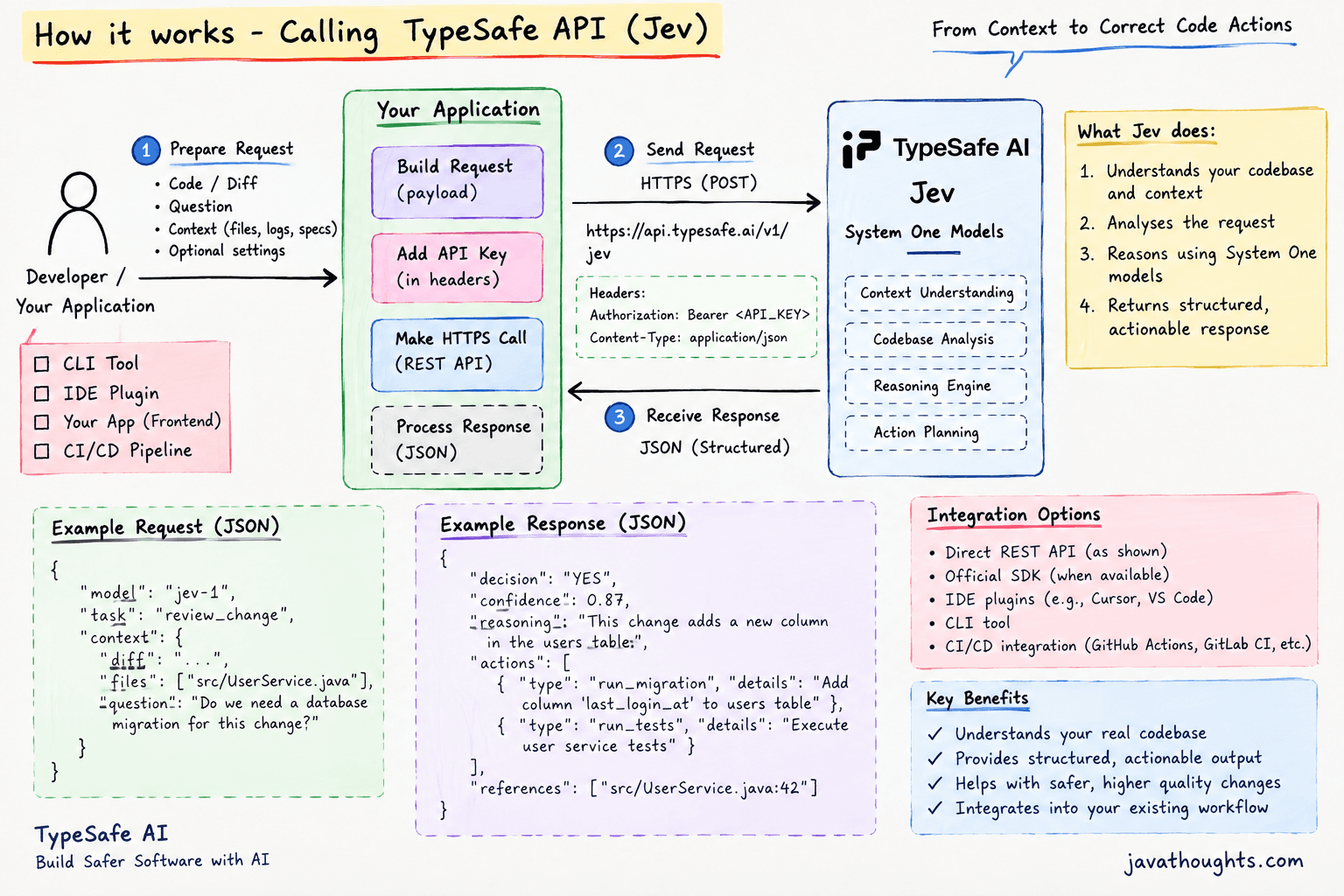
2. How It is Different From an LLM?
The mental model most engineers already have — prompt in, tokens out, parse the JSON and hope it's valid — doesn't apply here. Jev skips text generation entirely:
- No autoregressive decoding. It evaluates all your typed questions against the input state in parallel, in a single forward pass — responding in 70–500 milliseconds, versus seconds for a frontier LLM completion.
- Nothing to parse, nothing to hallucinate in the traditional sense — because the answer space is closed and predefined (yes/no, a fixed list, a 0–1 score), the model can't return malformed JSON or invent an option that wasn't in your schema.
- Adding more questions is cheap. Because each typed question is scored independently against the same state, batching more questions into one call barely moves latency.
3. Where Exactly Can We Use Jev?
Anywhere you currently have a rules engine, a hand-tuned scoring model, or a human doing rapid triage on structured data:
- Fraud/anomaly scoring on transactions
- Ticket/alert triage and routing (security ops, fraud ops, customer service queues)
- Document classification (onboarding intake, application categorization)
- Sentiment/urgency scoring on customer communications
- Content moderation and compliance flagging
- Pre-screening steps ahead of a heavier LLM or human review
The common thread: high-volume, repeated decisions over a known, closed answer set — not open-ended generation.
4. How It is Optimizing Cost Compared to an LLM?
This is where it gets interesting for anyone running inference bills through finance review. Jev is priced at $0.042 per million input tokens, with no charge for output tokens — the architecture makes output too cheap to meaningfully meter, since it's returning probabilities, not paragraphs. One comparison circulating puts Jev's cost at $0.39 per 1,000 workflows, versus $3.31 for GPT-5.6 Luna and $19.49 for Claude Haiku 4.5 on the same workflow type — roughly an order of magnitude (or two) cheaper for this specific job.
Worth a sanity check before you build a business case on it, though: an open-source competitor called Laya (more on that in section 10) claims to answer a single typed question in about 33 milliseconds on a single T4 GPU, self-hosted, at zero marginal token cost — versus Jev's independently measured 236–276ms p50. If that holds up, it changes the cost conversation for anyone who can self-host.
5. What Are the Restrictions — Where Is Jev Not Useful?
Don't reach for this where you actually need:
- Open-ended generation — drafting a customer email, writing code, summarizing a document in prose. It's not built to write; it's built to decide.
- Novel answer spaces — if you can't enumerate the possible answers ahead of time, Jev has nothing to score against.
- Explanation-heavy outputs — you get a probability, not a rationale. If a regulator wants a written justification for why a transaction was flagged, that's a separate step.
- Anything requiring on-prem/VPC deployment today — see the next section, because this is the one that matters most for a regulated engineering org.
6. When Is Jev Available for Private VPC? What About Security?
Right now: it isn't. Jev ships as a closed, managed API — the weights aren't open, and there's no self-hosted or VPC/on-prem option. Early access is currently gated behind a waitlist.
For a large financial institution, this is the whole ballgame. VPC or on-prem deployment is typically the line between "lightweight enterprise SaaS" and "infrastructure a security team will actually sign off on" — it's what lets code, prompts, and runtime traffic stay inside systems the organization already controls, which matters enormously for anything touching real account or transaction data under regulatory obligations. Until TypeSafe offers that, sending live customer or transaction state to an external closed API is a non-starter for production use at institutional scale.
7. How Could This Work in a Real Finance-System Application?
Assume the VPC gap gets closed eventually, or that you're scoping use cases that don't require it. Realistic applications for a large financial organization:
- Real-time transaction fraud scoring — typed question: "Given this transaction and account history, is this fraudulent?" with a calibrated probability, feeding a downstream decision (auto-approve, hold, escalate).
- Alert triage in fraud/AML ops — instead of a human analyst opening every compliance-adjacent alert, Jev pre-scores urgency and likely disposition, so analysts spend time on the ambiguous middle rather than the obvious 90%.
- Loan/credit application pre-screening — typed classification against defined criteria before a full underwriting model or human reviewer engages.
- Customer service routing — classify inbound requests (dispute, fraud report, general query, urgent) and route with a confidence-based auto-handle vs. escalate-to-human split.
8. First Steps: Trialing Jev in Pre-Prod With Synthetic Finance Data
This is the realistic on-ramp, and it sidesteps the VPC blocker almost entirely:
- Use existing synthetic transaction datasets. Large financial organizations already generate synthetic data for fraud model testing, load testing, and QA — that same pipeline becomes a safe sandbox, since no real PII or account data ever reaches TypeSafe's API.
- Validate calibration before you validate the business case. Run known fraud/non-fraud synthetic patterns through Jev and check whether its confidence scores are actually meaningful — does "0.85 probability of fraud" really correspond to fraud roughly 85% of the time on your data distribution? That's the whole premise of a "calibrated decision" model, and it's exactly what you can measure without production risk.
- A/B against your existing rules engine. Run the same synthetic scenarios through your current fraud/routing logic and through Jev, and compare disagreement rate and confidence-weighted accuracy.
- Keep it contained to non-sensitive workflows first — document classification on synthetic onboarding docs, alert triage on synthetic tickets — before anything resembling live transaction data.
9. What Else Is TypeSafe AI Doing?
Beyond Jev itself, a few things worth watching:
- TypeSafe reports accuracy benchmarks using an average of GPT-6 Astra and Claude Fable 5.1 responses as a reference point — worth reading with some caution, since TypeSafe designs its own evaluations and independent third-party benchmarks are still limited.
- The company is valued at roughly $200 million post-seed, which signals real investor appetite for this "narrow decision model" category as distinct from general-purpose LLMs.
- The competitive response has been fast — which brings us to the last question.
10. Is Laya the Same as TypeSafe? What's the Difference?
No — Laya is a separate, open-source project from a different company, ConvAI Innovations, released as a direct answer to Jev. ConvAI launched Laya days after TypeSafe's Jev announcement, positioning it as roughly 8x faster and eliminating per-token cost entirely.
Key differences worth knowing before you pick one to evaluate:
| Jev (TypeSafe) | Laya (ConvAI) | |
|---|---|---|
| Weights | Closed API | Open, Apache 2.0 |
| Deployment | Managed API only, no VPC/on-prem yet | Self-hostable |
| Cost | $0.042 / 1M tokens | $0 self-hosted |
| p50 latency (1 question) | 236–276 ms, independently measured | 32.8 ms |
| Language coverage | No published multilingual benchmark | 45 of 51 languages benchmarked |
| Calibration (ECE, lower is better) | 0.246 | 0.081 — about 3x better |
For a large financial institution specifically, the open-weights angle is arguably the bigger story than the speed numbers: self-hosting Laya inside your own VPC or data center sidesteps the exact compliance blocker that currently rules Jev out of production use. That's worth testing in your pre-prod sandbox alongside Jev, not as an afterthought.