
- Published on
- Views
Intel -29%, Reddit -29%, Amazon Burning $42B: Friday's Sell-Off, Explained for Engineers
- Authors

- Name
- Javed Shaikh
Friday evening I was half-watching the markets while waiting for a build to finish, and my phone started buzzing like it was 2022 again. Intel down 29%. Reddit down 29%. Amazon sliding. Nasdaq having its worst month since March 2025. Over a trillion dollars of market value gone in one session, which is roughly the GDP of a mid-sized country, or about four months of Amazon's capex budget. (That's a joke. Sort of. We'll get to it.)
And every headline said the same thing: the AI bubble is popping.
So I did the boring thing and actually read the three earnings reports. And honestly? That's not what they say. Three companies had three completely different bad days, and the market smushed them into one scary story. If you write code for a living, the real picture is a lot more useful than the headline. Let me walk you through it with the notes I scribbled while reading.
Compute demand is fine. The bill for building it just arrived, and the market is working out who pays. Skip to the end if you only want the "what do I do" part.
Intel: the AI side is fine, the PC side is having a rough time
Here's the funny part about Intel. The quarter was good. Revenue up 21% to $16.5 billion. Data-center revenue up 78%. Beat on revenue, beat on earnings. If you'd only read the first page of the report you'd have bought the stock.
Then you turn to the forecast.
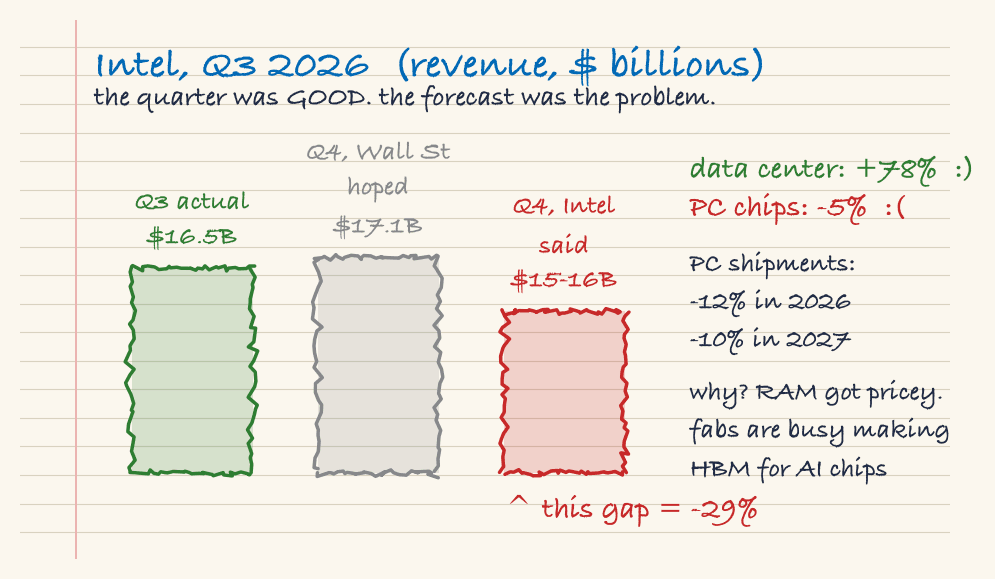
Intel told Wall Street to expect $15 to $16 billion next quarter. Wall Street was expecting about $17 billion. The CFO said, and I'm paraphrasing only slightly:
"The PC slowdown continues at least through the first half of next year. Sorry."
They now think PC shipments fall about 12% this year and another 10% in 2027. PC chip revenue was already down 5%.
And the reason PCs are weak is the bit I find genuinely interesting. It's memory. The fabs that make DRAM have shifted a chunk of their capacity to high-bandwidth memory (HBM), the stuff that goes next to AI accelerators. Less ordinary RAM gets made, so it costs more, so laptops cost more, so fewer get sold. AI didn't hurt Intel by replacing it. AI hurt Intel by eating its lunch at the memory counter.
You can see it in who else fell. Dell dropped 13%, AMD 10%, both PC-heavy. Nvidia, which stopped caring about PCs a long time ago, fell 3% and basically shrugged.
What this means for you
- RAM is going to stay expensive for a while. If you're speccing dev laptops, build boxes, or CI runners for next year, memory is the line that's going to make your finance person sigh.
- Enterprise PC refresh cycles are going to stretch. If you ship desktop software, your users are keeping that 2022 ThinkPad longer than you'd like.
- AI silicon demand is not the problem here. Intel's data-center business grew 78%. The money is still pouring into accelerators and the memory that feeds them. That's literally what's starving the PC side.
Amazon: AWS is growing faster than it has in five years, and somehow that's the bad news
Amazon's quarter, in one line: they made a lot of money and spent even more.
Revenue up 12% to about $202 billion. AWS up 39% to $46 billion, which is its fastest growth in nearly five years, with a backlog of signed contracts around $578 billion. Earnings per share came in at $1.89 against an expected $1.96 or so. A small miss, nothing dramatic.
Then there's the cash flow line, which is where everyone's eyes went.
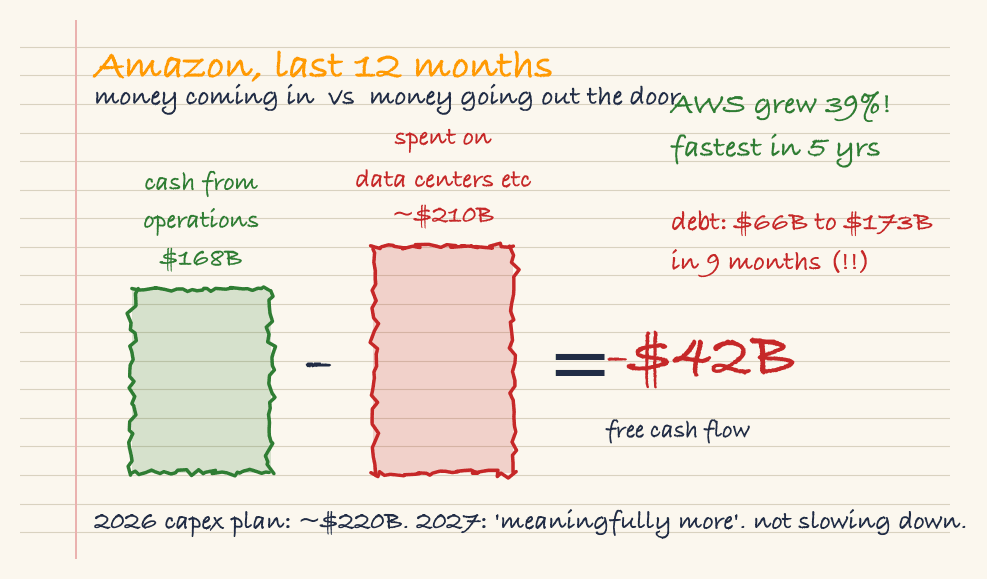
Over the last twelve months, Amazon's free cash flow was negative $42.4 billion. Capex in this one quarter was around $76 to $77 billion, more than double last year's same quarter. They're planning about $220 billion for 2026, most of it for AWS, and said 2027 will be "meaningfully more." Long-term debt went from about $66 billion to $173 billion in nine months.
So, to be clear: Amazon is borrowing money to build data centers at a pace that would make a 2021 crypto miner blush. And investors are asking the obvious question, which is "when does this pay off?" Totally fair question if you own the stock.
But you're probably not here as a shareholder. You're here as someone who runs stuff on AWS. And for you, this is a very different story.
What this means for you
- AWS is not slowing down. 39% growth and a half-trillion-dollar backlog means customers are signing long contracts for capacity. Those GPU instance shortages should ease as this build-out lands.
- Amazon needs that spend to pay off, which means they're going to try very hard to get you onto their own silicon. Expect more Trainium and Inferentia nudges, sharper Bedrock pricing, and generous-looking deals for committing to reserved capacity. The savings are real. So is the lock-in. Decide with your eyes open.
- Watch the pricing. When a company has $173 billion in debt and a lot of empty racks to fill, it does one of two things: discount to fill them, or raise prices on the stuff you can't easily move away from. Cloud has done both before.
Reddit: the first real casualty of AI search
Reddit also beat, by the way. Revenue up 53% to $895 million. Lovely. Then they guided next quarter to $1.02 billion, a bit under what analysts wanted, and gave a reason that I think is the most important thing anyone said on Friday.
Steve Huffman, Reddit's CEO, said search traffic from Google went:
"down meaningfully this quarter, because of AI.
One report put the decline at more than a million visits a week on average through October. Reddit warned that its daily users, starting from about 130 million, could shrink by a low double-digit percentage next quarter if this keeps going. They're also going to test making people log in to use the site.
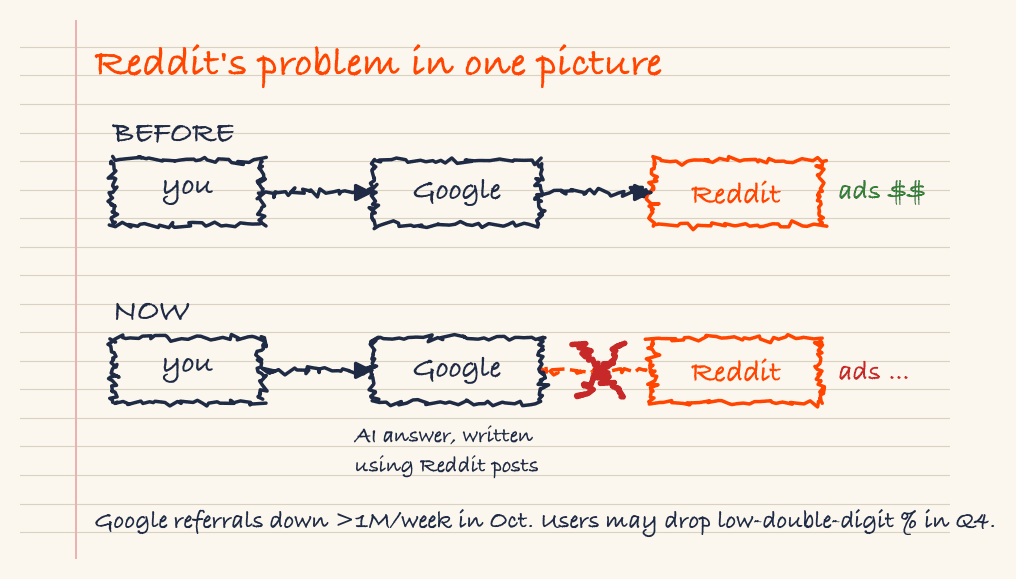
Sit with that for a second. Reddit's posts get used to train and ground AI answers. Those AI answers now show up right inside Google. People get what they needed without ever clicking through. The company that wrote the content loses the visit. We've all been predicting this for two years. Now it's in an earnings call with a number attached.
Snap fell about 5% and Pinterest 4% in sympathy, which isn't much, but it tells you investors have started asking every ad-supported site the same question.
What this means for you
- If your product lives on search referrals, Friday was your early warning. Docs sites, content platforms, Q&A communities, dev tools that grow through SEO: the funnel is being rerouted through AI answers, and you don't own that layer.
- Login walls, API pricing, and data-licensing deals are going to multiply. Reddit's testing one now. More will follow, which means more friction if you scrape and more cost if you license.
- Direct channels matter again. Newsletters. Apps. Communities you actually own. The things that felt optional when Google sent you free traffic are now the only traffic you can count on. (Yes, I'm aware I'm saying this on a blog that gets traffic from Google. The irony is not lost on me.)
So. Is the AI boom cooling or not?
Compute demand? Not cooling. AWS grew 39%. Intel's data-center business grew 78%. The memory makers are so busy serving AI that the PC market is starving. Every one of those is a sign of more AI infrastructure spend, not less.
What's actually being repriced is narrower: who pays for the build-out, and who gets paid by it.
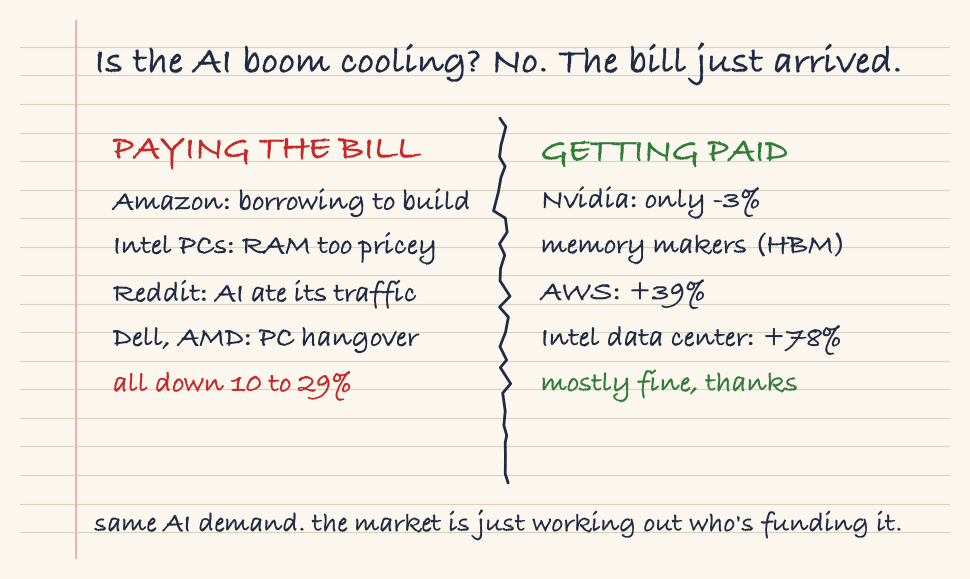
- Amazon pays, with borrowed money, and investors want to see the receipt.
- Intel's PC business pays, sideways, through memory prices it doesn't control.
- Reddit pays, by losing the traffic AI answers used to send it.
The companies on the other side of that trade, Nvidia, the memory makers, the cloud AI divisions, had a bad Friday too, but a mild one. That's not a bubble bursting. That's a market sorting winners from bill-payers.
A few investors told Reuters this was basically "what goes up must come down" after a long run. The Nasdaq is about 7.8% off its high, which is a pullback, not a crash. Whether it turns into something worse depends on the next few quarters of cloud earnings, not on one Friday.
Three things I'm watching
- Microsoft and Google's next capex numbers. If they also go cash-flow negative and keep spending, the "who pays" question gets louder. If they pull back, GPU capacity gets tighter and your prices go up.
- Memory prices through early 2027. Intel says the PC slowdown lasts at least through mid-2027. That's your hardware budget, right there.
- Google's AI search rollout. Reddit is the first company to put a number on referral loss. Watch who's next, and go look at your own analytics for the same curve.
What I'd actually do this week
- Check your traffic sources. If Google organic is more than half your acquisition, start building a direct channel now, not next quarter.
- Budget for memory. Whatever you were going to spend on RAM next year, add a cushion.
- Be suspicious of cloud discounts. A great deal on reserved AI capacity is a great deal right up until you need to leave.
- Don't panic about your career. Friday's numbers say more AI infrastructure is coming, not less. The demand for people who can build on it goes up even when the stocks go down. Stocks are not your skills.
That's it. Three companies, three different problems, one very dramatic Friday. If you read it as "AI is over," you'll make the wrong decisions. If you read it as "the bill arrived," you'll make better ones.
If you think I've got any of this wrong, tell me in the comments. I'll update the post, I'm not proud.
Sources I used: CNBC's coverage of the Intel, Amazon and Reddit earnings, Amazon's Q3 call transcript, Reuters' market wrap, NBC News on the $1 trillion figure, and 24/7 Wall St for the Dell, AMD, Nvidia, Snap and Pinterest moves. Share-price drops are closing figures for 30 October; intraday numbers were different.