
- Published on
- Views
How Vibe Coding is Reshaping Software Engineering in the AI Era
- Authors

- Name
- Javed Shaikh
1. Introduction: The Age of Vibe Coding
Imagine a scenario: You need to implement a complex, high-performance caching layer in Go, fully instrumented with Prometheus metrics and backed by a distributed Redis cluster. A few years ago, this task would have taken days of planning, writing boilerplate, and debugging. Today, an ambitous software engineer describes the system architecture to an advanced AI, reviews the intelligently generated code, tweaks a few performance constraints, and deploys it—all within an hour.
This isn’t just improved autocomplete; this is Vibe Coding.
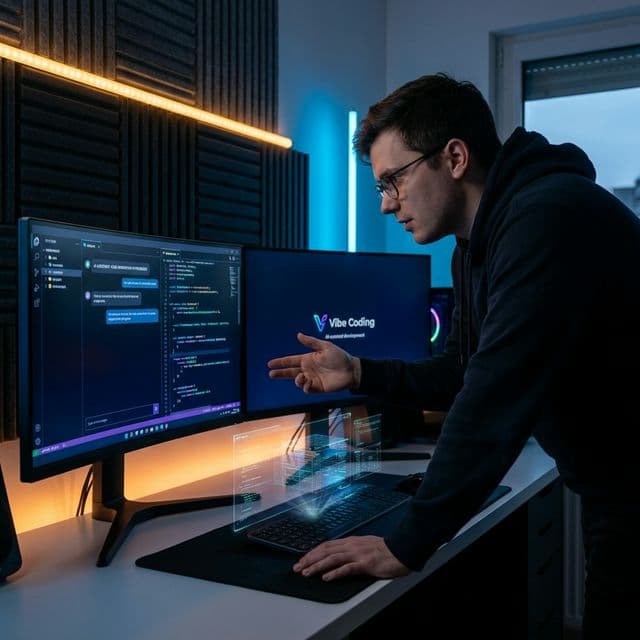 A software engineer collaborating with an advanced AI interface, the essence of 'Vibe Coding'.
Vibe Coding is fundamentally changing the way we interact with software. It shifts the primary engineering bottleneck from writing syntactically correct code to articulating intent, defining constraints, and reviewing logic. This shift is reshaping what it means to be a software engineer. For mid-level and senior engineers, this isn't a replacement of your role—it's an evolution.
2. What is Vibe Coding? (Beyond the Hype)
In technical terms, "Vibe Coding" refers to the highly interactive, intent-driven paradigm of AI-assisted development. Instead of writing code line-by-line, engineers provide high-level abstractions, pseudo-code, or natural language prompts, and Large Language Models (LLMs) output functional implementations.
It relies heavily on the context window of modern LLMs, which can hold an entire repository’s architecture in memory. When you prompt an AI, the model predicts the most statistically probable sequence of tokens that aligns with your intent, constrained by the provided codebase context.
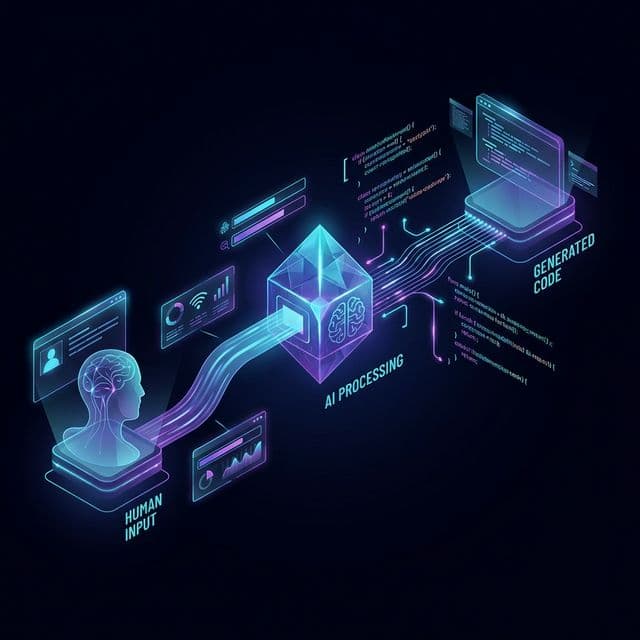 The modern software lifecycle: Human Intent → AI Processing → Generated Code → Review & Deployment.
Traditional Coding vs. AI-Assisted Coding
- Traditional Coding: Engineer translates business logic into syntax. Focus is on how to build it.
- AI-Assisted Coding (Vibe Coding): Engineer prompts the AI with business logic and architectural constraints. Focus is on what to build and why. Quick iterations and context steering define the workflow.
Prompt engineering in this context isn't just about adding "please." It’s about explicitly defining system constraints, expected payload structures, error handling boundaries, and performance benchmarks so the AI can generate production-ready code.
3. How It Impacts Software Engineers
The integration of AI into our daily workflow is driving several profound changes in the discipline of software engineering.
Faster Prototyping
Idea-to-prototype velocity has skyrocketed. You can stand up a full-stack Next.js and Spring Boot application with a functioning database schema in minutes, allowing you to validate architectural decisions rapidly before committing large engineering resources.
Reduced Boilerplate
No one enjoys writing CRUD endpoints, ORM configurations, or repetitive test mocks. AI drastically reduces the time spent on these commoditized tasks, freeing engineers to focus on complex domain logic.
Shift from Coding to Reviewing
As AI generates more of the initial implementation, the engineer's role pivots toward code review. You transition from a "writer" to an "editor," verifying that the generated logic handles edge cases, respects security boundaries, and aligns with the overall system architecture.
Rise of AI Pair Programming
AI acts as an infinitely patient, highly knowledgeable pair programmer. Whether you are debugging a complex concurrency issue or exploring a new framework, having a constant collaborator accelerates learning and problem-solving.
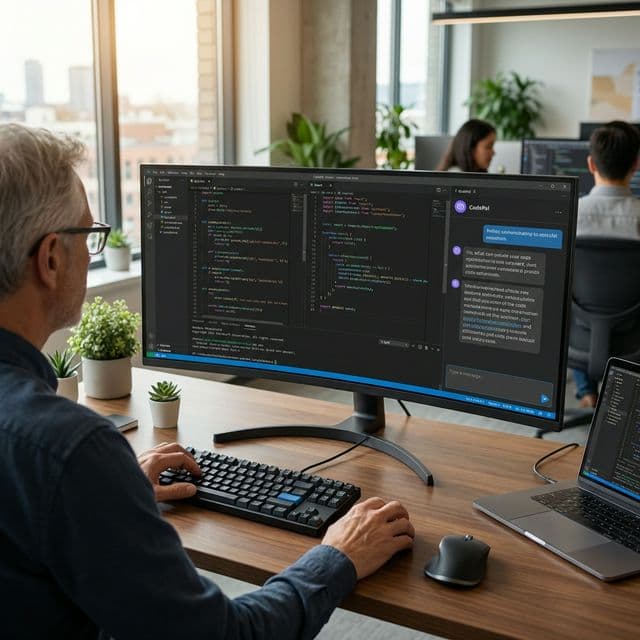 A senior software engineer engaging in AI pair programming, seamlessly reviewing code alongside an AI assistant.
Risk of Shallow Engineers
There is a looming risk: the "shallow engineer." If you rely purely on AI to solve problems without understanding the underlying mechanics, you will struggle to debug complex production failures or optimize system performance when the AI’s simple intuition breaks down.
4. The Real Risks Nobody Talks About
While AI-assisted development is a massive productivity multiplier, treating it as an infallible oracle introduces dangerous systemic risks.
 The hidden dangers of unreviewed generated code: security vulnerabilities and exploding technical debt.
- Security Vulnerabilities in AI-Generated Code: LLMs are trained on public repositories, which are full of security flaws. If you aren't carefully reviewing the generated code, you might inadvertently introduce SQL injection vectors, cross-site scripting (XSS) vulnerabilities, or insecure cryptographic implementations.
- Hallucinated Libraries/APIs: AI models can confidently invent non-existent packages, libraries, or API endpoints. Blindly accepting these suggestions can lead to broken builds or, worse, supply chain attacks if a malicious actor registers the hallucinated package name.
- Technical Debt Explosion: Because code is so cheap and fast to generate, it is easy to accumulate massive, poorly structured codebases. Without strong architectural boundaries, AI generation can lead to spaghetti architecture at an unprecedented scale.
- Skill Degradation: If you stop doing the hard work of deep debugging and system design, your analytical muscles will atrophy. You must actively work to maintain your fundamental engineering skills.
- Overconfidence Bias: Engineers often exhibit extreme trust in a block of clean, well-commented AI-generated code, leading to superficial code reviews and bugs slipping into production.
5. The Engineers Who Will Survive and Thrive
To remain highly valuable in the AI era, software engineers must stop competing with AI on writing syntax and instead focus on the areas where human intuition, strategic thinking, and deep technical context are irreplaceable.
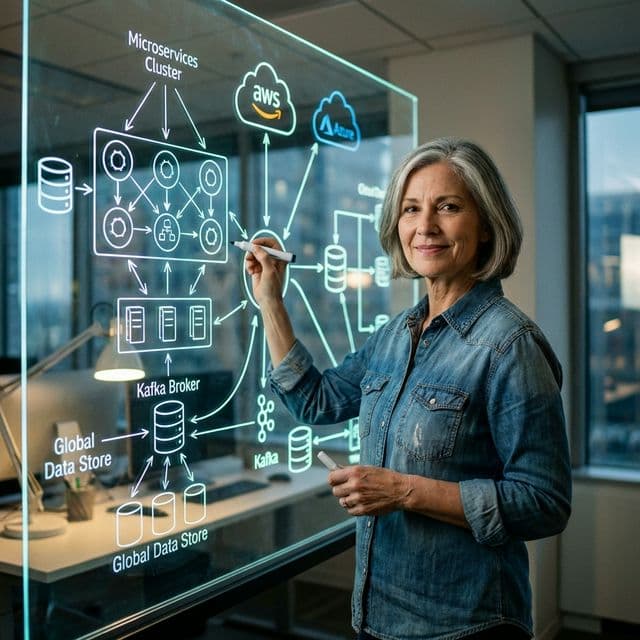 Senior engineers must focus on complex system architecture and distributed systems design.
System Design Mastery
AI is great at writing isolated functions, but it struggles to design robust, globally distributed systems that balance latency, consistency, and fault tolerance. Deep expertise in system architecture will be your strongest differentiator.
Distributed Systems Understanding
Understanding consensus algorithms, message broker semantics (like Kafka), event-driven architectures, and database internals will remain highly relevant. When a production system fails under load, AI cannot easily pinpoint the design flaw without deep human guidance.
Security Fundamentals
You must become a more rigorous reviewer. Understanding OWASP top 10, secure system design, and zero-trust architecture is critical. You are the final line of defense against AI-generated vulnerabilities.
Performance Optimization
AI often chooses the most generic, “average” solution. When you need to optimize memory allocation in C++, tune garbage collection in Java, or write highly optimized SQL queries for petabyte-scale data, human expertise is required.
Observability and Debugging
Knowing how to instrument a system, read distributed traces, analyze heap dumps, and debug complex production outages are skills AI cannot fully replicate yet.
Cloud and DevOps Knowledge
Deploying, scaling, and managing infrastructure reliably via Infrastructure as Code (IaC) and Kubernetes will continue to be essential domains where human oversight is critical to maintaining high availability and controlling costs.
AI Literacy
You must understand how these models work—their limitations, how context windows function, tokenization, and vector databases. An engineer who understands the tool can wield it far more effectively than one who treats it as a magic black box.
6. 5-Year Survival Roadmap for Engineers
If you are a mid-level or senior engineer feeling uncertain about the future, here is a practical, actionable 5-year roadmap to ensure you not only survive but thrive in the age of Vibe Coding.
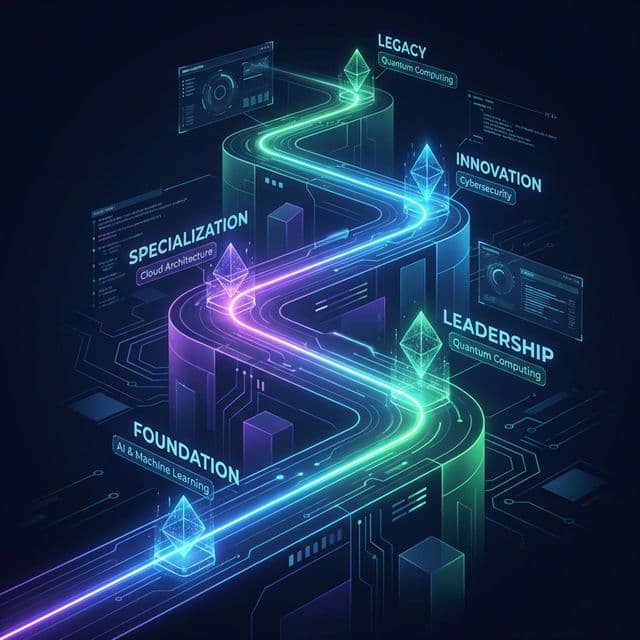 A clear, step-by-step roadmap to navigate and dominate the changing landscape of software engineering.
- Year 1: Master AI Tools & Revisit Fundamentals
- Integrate AI coding assistants fully into your daily workflow. Learn advanced prompt engineering.
- Re-read classic fundamentals: "Designing Data-Intensive Applications" and "Clean Architecture."
- Year 2: Deep System Design & Observability
- Transition your focus from writing application code to designing distributed systems.
- Master observability tools (Prometheus, Grafana, Datadog) to understand systems in production.
- Year 3: Security & Scalability at Scale
- Deepen your knowledge of secure coding practices and threat modeling.
- Focus on designing systems that can scale horizontally with zero downtime.
- Year 4: AI Integration into Products
- Move beyond using AI to write code, and learn how to build AI-powered features (RAG, vector embeddings, agentic workflows) into your own products.
- Year 5: Technical Leadership & Architecture
- Position yourself as a technical leader. Guide teams, set architectural standards, and define how human engineers and AI agents collaborate effectively.
7. Final Conclusion
AI will not replace strong software engineers. It will, however, replace engineers who refuse to adapt.
The future of software engineering is incredibly exciting. By embracing AI as a powerful productivity multiplier, we can shed the drudgery of boilerplate and focus on solving truly complex, high-impact business problems. The successful software engineer of tomorrow is part robust architect, part rigorous code reviewer, and part AI conductor.
Embrace "Vibe Coding," refine your architectural intuition, and prepare to build systems at a scale and speed that was previously unimaginable.