
- Published on
- Views
How WhatsApp Inserts Ads Between Statuses: The Hidden System Design
- Authors

- Name
- Javed Shaikh
1. The Swipe That Triggers a War
You're on your couch.
Tapping through WhatsApp Statuses. A friend's birthday party. A blurry concert video. Someone's morning coffee.
Swipe. Next status.
Swipe again.
And then — a crisp, high-definition video ad for running shoes plays. No buffering. No lag. It feels as natural as the status before it.
You swipe past it without thinking.
But as a backend engineer, this moment should stop you cold.
How did that ad get there?
Who decided it was the right ad for you?
And how did it load instantly — without breaking the experience for two billion users?
Behind that single swipe, a massive distributed system just fought a silent war. Thousands of servers across the globe coordinated. Machine learning models ran inference. A real-time auction completed. A winner was picked. A creative was fetched from a CDN.
All of it — in under 100 milliseconds.
This is the story of the hidden system design behind WhatsApp Status ads.

2. The Hidden Engineering Problem
Let's get the easy part out of the way.
Showing an ad to 10 users is trivial. Query a database, pick an ad, return it. Done.
Now imagine doing that for 2 billion monthly active users.
Millions of status views happening every second.
Users spread across 180 countries, each expecting the app to respond in the blink of an eye.
Here's what makes this problem brutal:
Latency budget is 100ms. Not 500ms. Not "best effort." If the ad decision takes longer, the system must gracefully skip it. No buffering. No jank.
Privacy is non-negotiable. WhatsApp chats are end-to-end encrypted. The ad system has zero access to message content. It must build its entire targeting model from metadata, interaction patterns, and linked Meta ecosystem signals.
Ads must feel invisible. A poorly timed or slow-loading ad doesn't just annoy users — it erodes trust in the platform. The insertion must be seamless. Native. Unnoticeable.
Peak traffic is unpredictable. New Year's Eve. A cricket World Cup final. A viral moment. Traffic can spike 10x in minutes. The system cannot buckle.
Showing an ad to 10 users is easy.
Showing it to 2 billion users — without slowing the app — is an entirely different game.
3. High-Level Architecture: How the Request Flows
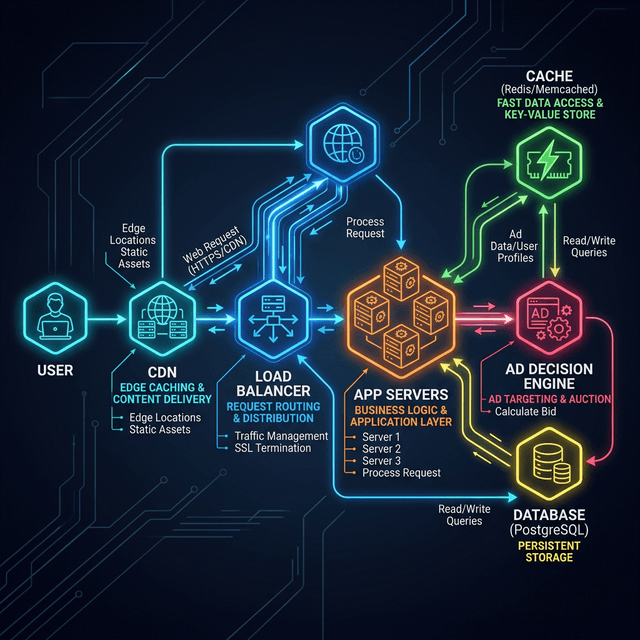
To serve a single ad inside a Status feed, the request passes through a carefully orchestrated pipeline of independent services.
Here's the high-level flow:
User App → CDN → API Gateway / Load Balancer → Status Feed Service → Ad Decision Engine → User Profile Service → Cache (Redis) → Distributed Database → Analytics Pipeline
Let's break it down with simple analogies:
The Load Balancer is the traffic police at a busy intersection. It doesn't process the request — it routes it to the right server instantly.
The Cache (Redis) is the ready-to-serve fridge. Hot data — like the user's recent ad history or top-performing creatives — sits here for sub-millisecond access.
The Database is the warehouse. It holds everything, but you don't walk to the warehouse every time you need a glass of water. You go to the fridge.
The Ad Decision Engine is the brain. It takes user context, runs it through ML models, executes an auction, and picks the winning ad — all within the latency budget.
The CDN is the delivery truck. Once the brain decides which ad to show, the CDN delivers the heavy creative (video, image) from a server geographically close to the user.
When a user opens the Status tab, here's what happens in milliseconds:
The WhatsApp client sends an async request to the backend: "User is about to view statuses."
The request hits the nearest Edge Node (a Point of Presence close to the user). TLS is terminated here — saving precious milliseconds.
The Status Feed Service fetches organic statuses and simultaneously fires a non-blocking gRPC call to the Ad Decision Engine.
The Ad Decision Engine retrieves user metadata, runs candidate retrieval, scores ads through ML models, and executes a real-time auction.
The winning ad's metadata (a lightweight JSON payload with creative URLs and tracking links) is merged into the status feed response.
The client receives the feed and begins downloading the actual heavy media from the CDN in the background.
The key insight? The Ad Decision Engine never touches the actual video or image file. It only decides which ad wins. The heavy lifting of media delivery is entirely offloaded to the CDN.
4. The Real Challenge: Scaling to Billions
This is where most systems break.
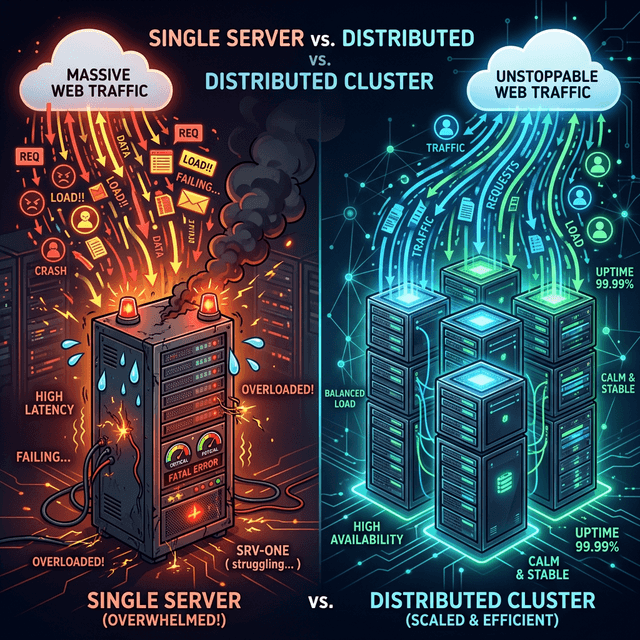
A single powerful server can handle maybe 10,000 requests per second. WhatsApp needs to handle tens of millions — simultaneously, across every continent.
Why a single server fails:
- One machine has finite CPU, memory, and network bandwidth.
- A single point of failure means one crash takes down the entire ad system.
- Users in Mumbai cannot wait 200ms for a round trip to a server in Virginia.
Why replication alone isn't enough:
- Copying data to multiple servers helps with reads, but introduces consistency problems. Which replica has the latest ad budget? Which one knows the user already saw this ad twice today?
Why distributed systems are mandatory:
- You need geo-distributed clusters — servers in Asia, Europe, Americas, Africa — each capable of making independent ad decisions using locally cached data.
- You need horizontal scaling — the ability to spin up thousands of stateless pods in seconds when India wakes up and opens WhatsApp.
- You need consistent ad insertion frequency — a user shouldn't see 5 ads in 10 statuses on one day and zero on the next. Pacing logic must be globally coordinated.
And here's the revenue reality:
Every 10ms of added latency in the ad pipeline means fewer auctions complete successfully. Fewer completed auctions mean fewer ads served. Fewer ads served means millions of dollars in lost revenue per quarter.
Speed isn't just a user experience concern. It's a business-critical metric.
5. The Monetization Layer: Completely Decoupled
One of the most critical architectural decisions is blast radius containment.
The team that builds WhatsApp messaging must never be woken up at 3 AM because an ad server pushed a memory leak.
The monetization layer is an entirely separate domain:
- Separate codebases. Separate deployment pipelines. Separate on-call rotations.
- Separate scaling clusters. The ad services autoscale independently based on their own traffic patterns.
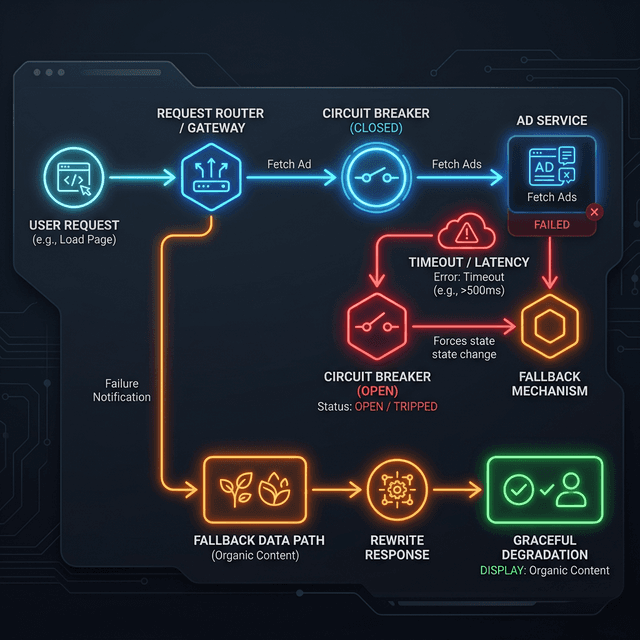
- Fail-open design. If the entire ad system crashes, the Status Feed Service simply skips the ad slot and returns organic statuses. The user never notices.
This is a non-negotiable principle: monetization failures must never degrade core product functionality.
The ad services are fundamentally stateless. All state — user profiles, ad budgets, impression history — lives in external stores (Redis, distributed databases, Kafka). This means the pods are disposable. Kubernetes Horizontal Pod Autoscalers (HPA) can spin up or tear down thousands of instances based on custom metrics like gRPC concurrent streams, not lagging indicators like CPU usage.
When traffic subsides, the cluster aggressively scales down. Elastic. Cost-efficient. Resilient.
6. Real-Time Ad Auction: The 100ms War
Now here's where it gets interesting.
At the core of the ad system is the Real-Time Bidding (RTB) engine — a highly optimized, concurrent scatter-gather architecture. Its job: pick the single most profitable and relevant ad out of millions of candidates.
In under 100 milliseconds.
The process works as a tight funnel:
Stage 1: Candidate Retrieval (100,000 → 1,000)
Querying a relational database for active ads would take seconds. Instead, the system uses In-Memory Data Grids and vector similarity search. Coarse filters — location, OS, broad interest categories — narrow the pool to roughly 1,000 eligible ads.
Stage 2: Lightweight Scoring (1,000 → 100)
A fast ML layer — typically Gradient Boosted Decision Trees or Logistic Regression — filters out ads the user is unlikely to engage with. The pool drops to 100.
Stage 3: Deep Learning Ranking (100 → 5)
The remaining candidates hit a Deep Learning Recommendation Model (DLRM). This neural network predicts exact Click-Through Rate (pCTR) and Conversion Rate (pCVR) by computing non-linear interactions between thousands of user and ad features.
Stage 4: Auction & Revenue Optimization (5 → 1)
The final auction runs. Using mechanisms like Generalized Second-Price (GSP) auctions, the system calculates:
eCPM = Advertiser Bid × Predicted CTR
The ad with the highest eCPM wins the slot. This ensures revenue is maximized while maintaining relevance.
All four stages execute via parallel threads with strict per-stage timeouts. If any stage exceeds its budget, it short-circuits and falls back to a cheaper model.
7. Ad Targeting Logic: The Smart Layer
How does the system know which ad to show you — without reading your chats?
User Segmentation:
The system builds user cohorts from metadata signals:
- Device type and OS version
- Approximate location (city-level, not GPS)
- App usage patterns (how often you view statuses, at what times)
- Interaction graph (who you message frequently, not what you message)
- Linked Meta ecosystem data (Instagram interests, Facebook ad interactions)
Frequency Capping:
If you see the same shoe ad five times in a day, you develop banner blindness — and the advertiser wastes money. The system uses distributed Bloom filters or Redis sorted sets to track impression history per user. Repetitive ads are algorithmically penalized during ranking.
Cold-Start Problem:
New users have no interaction history. The system handles this with population-level priors — showing broadly popular ads until enough signal accumulates to personalize.
The Core Trade-off:
More personalization means higher relevance — but also higher latency (more features to compute, heavier models to run). The system constantly balances targeting accuracy vs. response time.
8. Failure Scenarios: When Things Go Wrong
At this scale, failure isn't a possibility. It's a certainty.
Servers die. Network cables get cut. Database disks fail. Entire data centers go dark.
The system isn't designed to avoid failure. It's designed to survive it invisibly.
Here are realistic failure cases and how the system handles them:
Cache outage (Redis cluster fails): The Ad Decision Engine falls back to the database — with a slightly higher latency. If that also fails, it serves a pre-cached default ad or skips the slot entirely.
ML inference service spikes to 200ms: The Circuit Breaker trips. Subsequent requests bypass ML entirely and serve from a pre-ranked cache of top-performing ads.
Ad service timeout: The Status Feed Service has a strict 80ms timeout on the ad call. If it doesn't get a response, it falls open — returning only organic statuses. The user never sees a spinner.
Network partition between regions: BGP Anycast routing at the edge layer reroutes traffic to the nearest healthy cluster. Latency might increase by 40ms, but functionality stays alive.
Traffic burst during Diwali or New Year's Eve: Auto-scaling kicks in aggressively. If scaling can't keep up, the system gracefully degrades — reducing the ML candidate pool from 100 to 10, or swapping the heavy DLRM model for a much cheaper Logistic Regression model.
The golden rule: if the ad system fails, show organic content. Never break the core experience.
If this system fails silently, it's good engineering.
If it fails visibly, it's not just a bug — it's lost revenue.
9. Optimization Techniques: Squeezing Every Millisecond
Operating tens of thousands of servers to run real-time auctions and neural networks is exorbitantly expensive. The engineering teams constantly wage war on latency and infrastructure costs.
Edge Caching:
Popular ad creatives are pre-positioned on CDN edge nodes closest to users. When the auction picks a winning ad, the video is already cached 50km from the user's phone.
Pre-fetching Ads:
The client doesn't wait for you to swipe to the ad slot. It pre-fetches the next batch of ads in the background the moment you open the Status tab.
Async Logging & Background Analytics:
Client-side telemetry — impressions, view durations, click events — is not streamed instantly. Events are batched on the device and sent over background network, saving server ingest costs and user battery life.
Binary Protocols:
Backend service-to-service communication uses gRPC and Protocol Buffers instead of REST/JSON. Binary serialization is faster, smaller, and cheaper at this scale.
Model Quantization:
Running DLRM inference on GPUs is fast but expensive. Engineers use quantization — reducing model weights from 32-bit floats to 8-bit integers — so inference runs cheaply on commodity CPU hardware without missing the 100ms deadline.
Circuit Breakers & Rate Limiting:
Every external dependency is wrapped in a circuit breaker. If a downstream service degrades, the breaker trips and routes to a fallback — preventing cascading failures across the cluster.
10. Engineering Trade-offs: The Hard Choices
No system at this scale is free from trade-offs. These are the tensions the engineering team navigates daily:
| Trade-off | Left Side | Right Side |
|---|---|---|
| Revenue vs. User Experience | More ads = more money | Too many ads = user churn |
| Personalization vs. Privacy | Better targeting = higher CTR | More data collection = trust erosion |
| Latency vs. Targeting Accuracy | Heavier ML models = better ads | Heavier models = slower response |
| Consistency vs. Availability | Exact budget tracking = fairness | Eventual consistency = higher uptime |
There is no perfect answer to any of these. The system is a living, breathing set of compromises — tuned, monitored, and rebalanced continuously.
The mark of a senior engineer isn't knowing the "right" answer. It's understanding which trade-off to make, and why.
11. Lessons for Backend Engineers
Studying this system provides a masterclass in modern backend architecture.
Here are actionable takeaways you can apply to your own systems:
Decouple the revenue layer. Never let monetization block core functionality. Ad systems must fail open. An unavailable ad is a minor loss. An unavailable app is a crisis.
Design stateless services. Push all state to external stores. This is the only path to violent, immediate horizontal scaling.
Use async event pipelines. Stop relying on synchronous REST for state updates. Drop events into Kafka. Return to the user instantly. Let background workers handle mutations.
Separate read and write paths. Don't let heavy analytical queries lock the tables needed for sub-millisecond reads. Implement CQRS patterns.
Enforce strict latency budgets. A system is only as fast as its slowest synchronous dependency. Use parallel scatter-gather and enforce hard timeouts everywhere.
Design for failure, not perfection. Circuit breakers, fallbacks, graceful degradation — these aren't nice-to-haves. They're survival mechanisms.
12. Final Thoughts
The architecture required to inject a 10-second video ad into a social feed is a breathtaking feat of modern distributed systems engineering.
It requires mastering the chaos of sharded databases, orchestrating thousands of stateless microservices, running ML inference at the edge, and relentlessly optimizing every byte on the wire.
The next time an ad appears between two statuses...
remember — behind that single swipe, a distributed system just made thousands of decisions in milliseconds.
And it did it for two billion people. Simultaneously. Without breaking a sweat.