
- Published on
- Views
How Shopify’s Event-Driven & Streaming Architecture Powers 66M Kafka Msg/sec
- Authors

- Name
- Javed Shaikh
Shopify processes some of the highest traffic loads anywhere — not just in e-commerce, but among global distributed systems. Behind the scenes, a streaming event core built on Apache Kafka enables this scale by decoupling services, enabling real-time analytics, and powering machine learning workflows.
🧠 What Does “66 Million Messages/sec” Mean?
When Shopify says 66 million messages per second at peak, this refers to how quickly Kafka brokers are ingesting and distributing events across the internal infrastructure. These events can include things like:
- Order created/updated events
- Inventory changes
- Customer actions
- System telemetry
- ML inference outputs
At these rates, millions of services and analytic jobs can consume real-time triggers without slowing down core transactions.
In other words:
- ✔ Kafka is the nervous system — carrying event “nerve impulses.”
- ✔ Producers don’t wait for consumers — they drop events and move on.
- ✔ Consumers can read at their own pace — enabling scalable asynchronous processing.
This pattern reduces coupling between parts of the system, improving resilience and developer velocity.
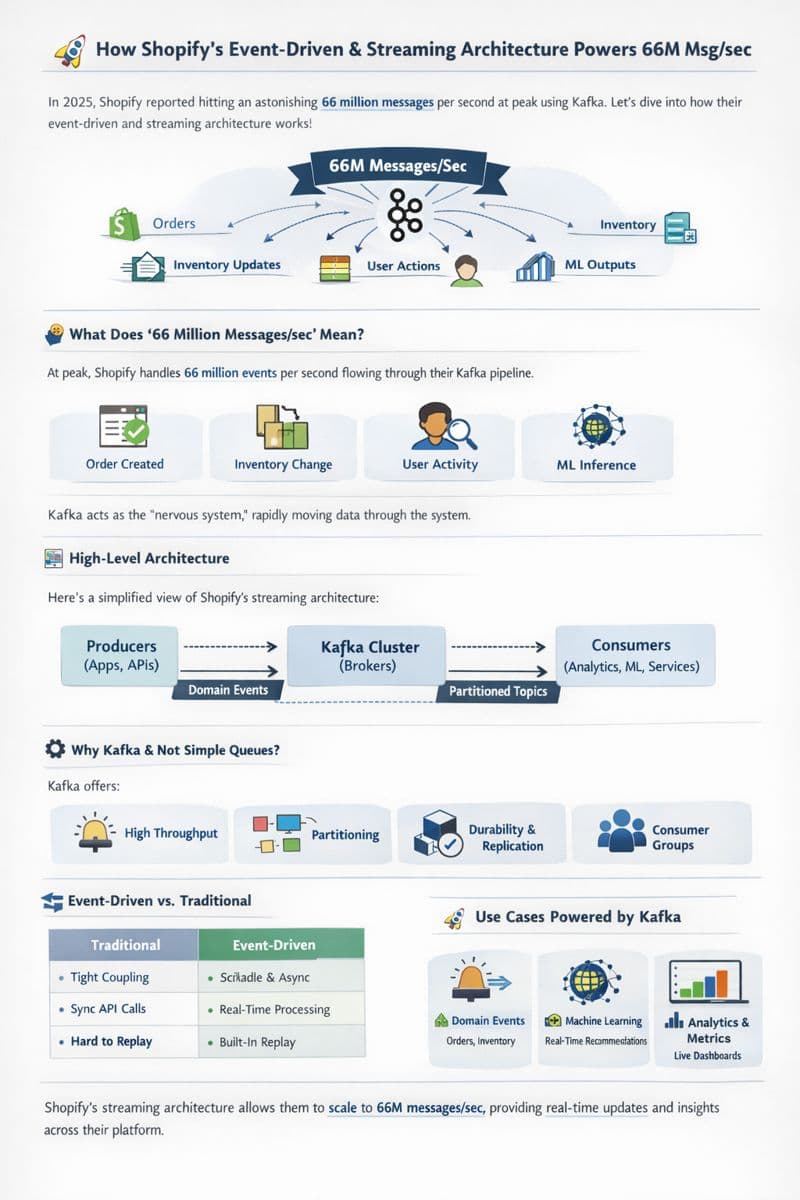
📊 High-Level Architecture (Conceptual Diagram)
Here’s a simplified architecture diagram of how events flow at Shopify:
   +-------------+          +--------------+          +----------------+
   | Producers   |  Kafka   | Kafka Cluster|  Kafka   | Consumers      |
   | (Apps, APIs) +-------->+ (brokers)    +-------->+ (services, BI) |
   +-------------+          +--------------+          +----------------+
            |                     |         |                |
            v                     v         v                v
      Domain Events          Partitioned Topics      Search Index/ML/Analytics
Notes:
- 📌 Producers generate events when something important happens (an order, inventory change, etc.).
- 📌 Kafka brokers buffer and replicate these for high durability.
- 📌 Consumers pull at their own speed — updating downstream systems like analytics clusters, search indices, ML jobs, dashboards, etc.
This decoupling is the heart of an event-driven architecture.
⚙️ Why Kafka & Not Simple Queues?
At massive scale, typical queues (e.g., Redis pub/sub or basic message queues) hit service limits quickly. Kafka delivers:
| Feature | Benefit |
|---|---|
| High throughput | Handles tens of millions of events/sec |
| Partitioning | Scales horizontally by spreading load across brokers |
| Durability & Replication | No single broker is a point of failure |
| Consumer groups | Multiple consumers can independently read the stream |
| Schema versioning support | Versions data formats safely |
Kafka excels where real-time and historical replay both matter, which is why Shopify uses it as the core.
🧱 Event-Driven vs Traditional
| Aspect | Traditional | Event-Driven (Shopify) |
|---|---|---|
| Coupling | Tight | Loose/async |
| Latency | Often synchronous API | Real-time batching |
| Scalability | Limited by DB & sync calls | Horizontal via Kafka |
| Replay | Hard | Built-in (Kafka retention) |
| Failure isolation | Poor | Strong |
This architecture frees teams to innovate independently — consumer teams can process slower analytics at their own pace while core business events stream at peak velocity.
🔁 Shopify’s Streaming Use Cases
Here are some core use cases powered by Kafka streams:
📦 Domain Events
Events like order created, product updated, and cart modified are published as Kafka messages. Consumers subscribe and update search services, cache layers, and user interfaces.
🤖 Machine Learning Pipelines
Real-time outputs — e.g., embeddings, predictions for recommendations — are produced from Kafka and used by downstream systems. Petrifying the event stream lets them apply business logic in near real time.
📊 Analytics and Metrics
Data teams consume Kafka streams to feed dashboards, analytical models, and long-term storage. This avoids batching delays and lets Shopify perform interactive analytics on current traffic.
🧩 Real-World Pipeline Example
A real-time buyer signal pipeline at Shopify might look like:
 Cart/Checkout → CDC Streams → Kafka (Monorail format) → Beam/Dataflow
       ↑
  Filtering, Structuring, Versioning
       ↓
 Downstream Consumers → Merchant UI / Inbox Notifications
Here:
- CDC stands for Change Data Capture (captures DB changes).
- Monorail is an internal event structuring layer for consistency.
- Beam/Dataflow handles transformation at scale.
🪶 A Note on Scale
These numbers underscore the scale Shopify operates at:
- ✨ 173 billion total requests in a 24-hr span
- ✨ 284 million requests per minute during Black Friday
- ✨ 66 million Kafka messages per second at peak
- ✨ Millions of DB reads/writes per second across MySQL clusters
- ✨ 216 million embeddings processed per day for ML workflows
This isn’t theoretical — it’s real traffic under extreme conditions like Black Friday and Cyber Monday.
🏁 Summary: Why This Matters
Shopify’s streaming and event platform enables:
- 🔥 Real-time responsiveness — analytics and ML process live events.
- ⚡ Extreme scalability — millions of messages per second without service degradation.
- 🔌 Decoupled services — each team or service can evolve independently.
- 📈 Replayability and durability — historical streams enable audits, debugging, and new features.
In 2025, this architecture is not just a tech brag — it’s a business necessity to support millions of merchants globally, during peaks like Black Friday and in everyday commerce workloads.